Theodore Roosevelt Schuyler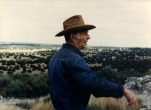
Ted Schuyler was born in Trinidad, Colorado on November 2, 1904, which was the day Teddy Roosevelt was elected President, hence the name. Ted was the son of John and Frances Schuyler, and had five brothers and two sisters. He attended the Art Institute of Chicago in the late 1920's, as well as having some art education in New York. He met his wife, Lee Clarke, while at the Art Institute, and they were married in 1932. The Schuylers set up residence in Albuquerque, New Mexico shortly after their marriage, and remained residents there until 1978 except for three years from 1942 - 1946 when they were in Gallup, NM and Ted worked at the Ft. Wingate Ordinance Depot as a civilian employee. Their first daughter Trudie was born in Albuquerque in 1939 and second daughter Noelle in Gallup in 1945. Returning to Albuquerque, Ted resumed active painting and teaching art classes associated with such groups as the Albuquerque Women's Club and the Wives Club at Kirtland AFB. His wife Lee did significantly less painting while the children were young, but resumed active work in her later years. |
Lee Clarke Schuyler
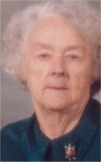
Lee (Leoline Louise) Clarke Schuyler was born in Chicago, IL in 1907, the daughter of architect Edwin B. Clarke and Louise Forestall. She attended the University of Illinois for a short while, and then began her art education at the Art Institute of Chicago, where she met Ted Schuyler. They were married in 1932. They lived in the Chicago area for a short while, but after a prolonged “painting tour” to Mexico in the mid 1930’s, settled permanently in New Mexico. Their first daughter, Trudie, was born in Albuquerque in 1939. When she was three, the Schuylers moved to Gallup so Ted could take up work as a civilian employee at the Ft. Wingate Ordinance Depot. This was not a happy time for Lee; both her aging parents were living with them for a while, and Louise died just after Christmas in 1944. Lee also had a miscarriage during their time in Gallup, and needed to stay effectively housebound in order to carry their second daughter, Noelle, to term. Shortly after Noelle’s birth in December of 1945, the Schuylers returned to Albuquerque. |
Trudie Schuyler Barreras

Trudie Schuyler Barreras, born Gertrude Louise Schuyler in 1939, was the first daughter of artists Ted and Lee Clarke Schuyler. Her first few months were spent in the patio apartments in what had originally been the Casa de Armijo in Old Town, Albuquerque. When she was three, the Schuylers moved to Gallup, New Mexico, where she remembers at least three separate domiciles – a unit in a motel that was renting long-term due to WWII gasoline rationing that limited tourism, a short stay with another family, and the “house on the hill” where grandparents Edwin and Louise Clarke lived with them. Trudie’s earliest memories include sketching trips out in the hills around Gallup with her parents, and incessantly drawing on paper bags and cardboard boxes. Her parents teasingly told her she was part of the cause of the paper shortage during the war.
Trudie drew constantly, and after the Schuylers resumed their residence in Albuquerque, she began going with Ted’s art classes on sketching trips during the summer when she was out of school. As it happens, one of Ted’s students was Trudie’s fourth grade teacher, and recounted that when Trudie had finished her schoolwork, she would occupy her time by drawing. Once when the principal visited the classroom and queried why the teacher allowed this, she pointed out that the regular work was completed, the activity was not disruptive, and why should the child’s creativity be challenged?
While attending Valley High School in Albuquerque from 1954 – 1957, Trudie was blessed to be able to take art classes with Frank Walker, an exceptionally good teacher as well as being an accomplished artist. During her senior year, she was one of two illustrators of the annual, an endeavor that took up most of the year. However, by the time she entered college in 1957, Trudie had decided that she didn’t have the “grit” to attempt to make a living as an artist, having observed through her childhood the extreme management skills her mother Lee had to develop in order to maintain a household on an artist’s income. Therefore she majored in Chemistry, only taking one art course from UNM professor Kenneth Adams, one of Ted’s favorite New Mexico painters. Of course, she continued to paint and draw, and as often as possible observed her parents at work.
Trudie married Ray Barreras in 1959, and their daughter Therese (Tish) and son Stephen were born in 1959 and 1961 respectively. There followed a move to graduate school in Michigan, where two more children, Lorna, born 1963, and Antonia, 1965, were added to their family. During the years from ’61 – ’66, Trudie completed an MS and Ray a PhD in Organic Chemistry. They then moved to Tuskegee, AL, where Ray taught full time in the Chemistry Department and Trudie did part time work teaching a science course for elementary school teachers. In 1969 the Barreras' adopted their fifth child, Carlos. During this time, due to family and job responsibilities, Trudie’s painting was sporadic, although she did a number of portraits and figure studies of students. At this time she learned to work in oils, and eventually decided that acrylics were easier and did just as well for what she wanted to portray.
In 1974 the family moved to Tsaile, AZ where Ray continued to teach full-time, and Trudie taught a course or two. She also purchased a horse, and due to the lovely scenery began to do a great deal more watercolor painting. In 1978 the entire family with the exception of Tish moved to Atlanta, GA. There, Trudie worked for an independent educational firm called Discovery Learning, Inc. until 1984. In the fall of that year, she began teaching Chemistry at Avondale High School in DeKalb County, GA, which continued until her retirement in 2003. Again, her painting was fairly steady, mostly occurring during the lovely spring and fall months when Georgia is at its most spectacular or on trips back to the Southwest. After Lee and Ted moved to Atlanta in 1987, Trudie enjoyed renewing her “studies” with her professional-artist parents. Since her retirement, however, she has gone into high gear, and until 2014 worked weekly with an art group. She began doing pastel portraits of pets and babies as an act of love for their “parents”, and has found this a most rewarding endeavor. After moving from GA back "home" to NM in 2014, she has mostly done acrylic and watercolor sketches from her own and her daughter Lorna's photographs of the fantastic mountain and canyon scenery she finds most fascinating.
Devon Kateri Gorman
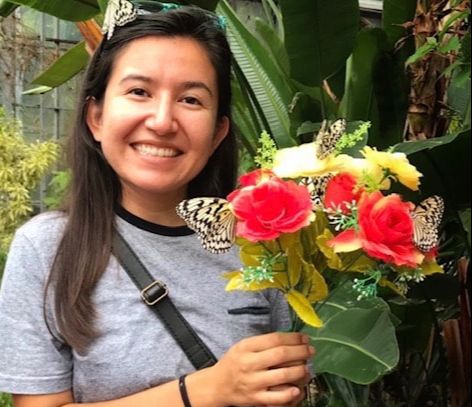

Toni is the youngest daughter of Ray and Trudie Barreras, and the first grandchild of Ted and Lee Schuyler to take up painting. Actually, her primary artistic skill is home decorating, which was first displayed in the home she and her husband Rick Cobb had as a primary residence in Dunwoody, Ga. A number of the paintings by the Schuylers featured on this website, and others, are in fact part of the Cobbs' collection. However, in recent years the Cobbs acquired a vacation home on Lake Hartwell, and Toni, while adding her own special touch to decorating there, decided to take up painting in acrylics. Although she declines to call them "art", considering them to be more in the craft category, the rest of us disagree, and are convinced that her grandparents would be delighted to welcome her to the website if they were still with us. After Rick retired and their children Sky and Connor graduated from high school, the Cobbs moved permanently to Anderson, SC, trading in the first lake house for another in a move favorable location on the lake. They also acquired a home in Anderson not on the lake, which Toni uses as office space and Connor has as his home. Sky lives in an Atlanta suburb.
Lorna Barreras